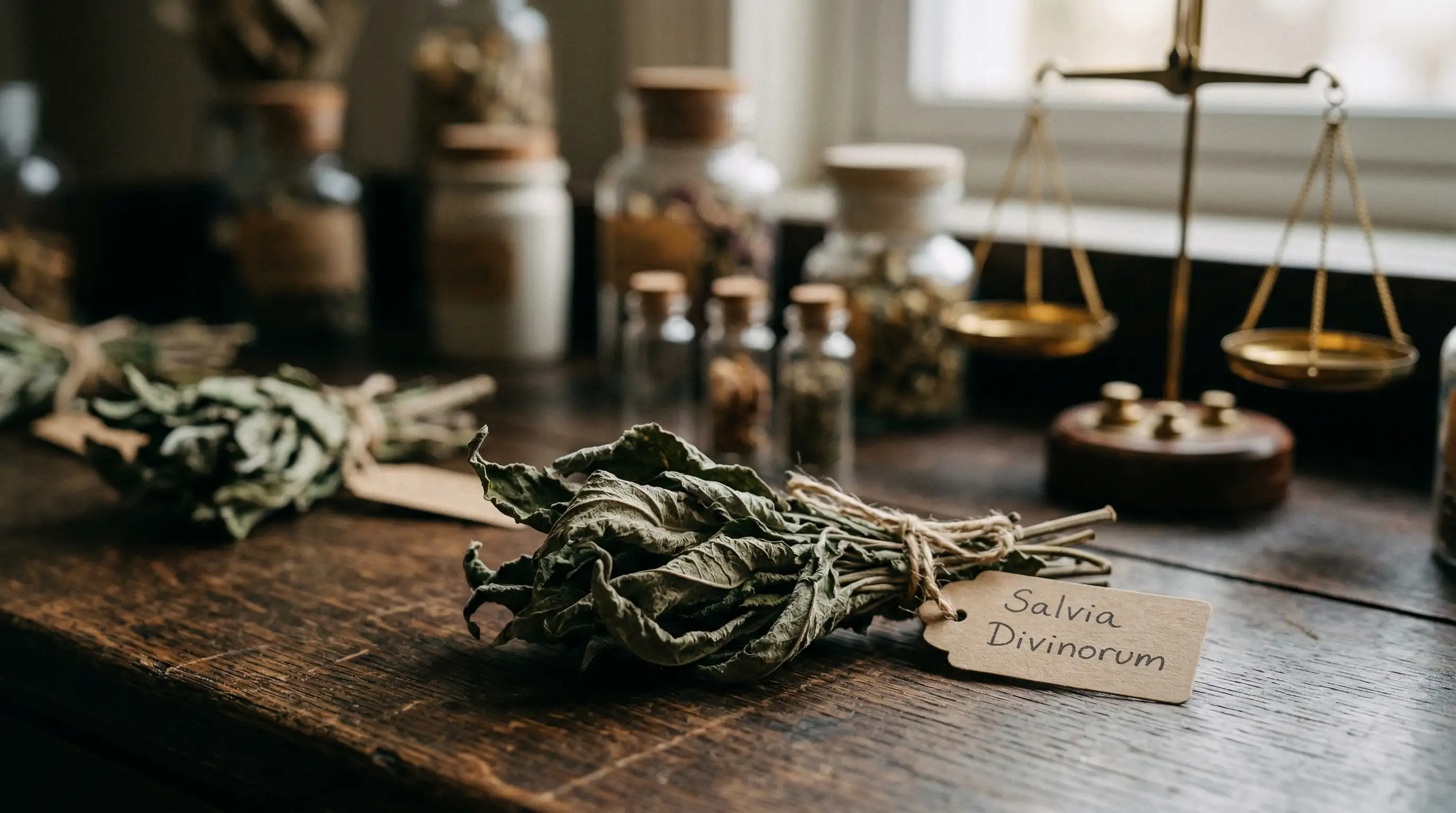
Salvia Divinorum
Always start with a low dose and read our safety guidelines before use.
Salvia divinorum is a psychoactive plant from the mint family, native to Mexico. Its active compound, salvinorin A, is a potent kappa-opioid receptor agonist that produces intense but short-lived psychedelic experiences. It is one of the most potent naturally occurring psychedelics.

Overview
Salvia divinorum, commonly known as "Diviner's Sage" or simply "Salvia," is a unique psychoactive plant belonging to the mint family (Lamiaceae). Native to the cloud forests of Oaxaca, Mexico, this perennial herb has gained international attention for its powerful, short-acting psychedelic properties. Unlike most other psychedelics, Salvia produces effects through an entirely different mechanism of action, making it one of the most distinctive and intense psychoactive substances known to science.
The plant contains the compound salvinorin A, which is notable for being the most potent naturally occurring psychedelic substance by weight. Even tiny amounts—measured in micrograms—can produce profound alterations in consciousness. These effects are characterized by their rapid onset, intense peak, and relatively short duration, typically lasting between 5 to 30 minutes when smoked, though the experience can feel much longer to the user.
People use Salvia for various reasons, including spiritual exploration, consciousness research, and curiosity about altered states. Traditional Mazatec shamans have used the plant for centuries in divination rituals and healing ceremonies, where it's considered a sacred teacher plant. In contemporary settings, users often seek the profound introspective experiences and reality-shifting effects that Salvia can provide. However, the intensity and unpredictable nature of Salvia experiences make it particularly important for potential users to understand both its effects and risks thoroughly.
The legal status of Salvia varies significantly worldwide. In the Netherlands, it remains legal and available through smart shops, though many countries have implemented restrictions or outright bans due to concerns about its potency and potential for adverse reactions. This legal accessibility, combined with its unique effects profile, makes comprehensive education about safe use practices essential for harm reduction.
How It Works
Salvia divinorum's psychoactive effects stem primarily from salvinorin A, a diterpene compound that acts as a highly selective kappa-opioid receptor (KOR) agonist. This mechanism of action is fundamentally different from classical psychedelics like psilocybin, LSD, or DMT, which primarily work through serotonin 2A receptor activation. The kappa-opioid system is involved in perception, consciousness, and dissociation, which explains why Salvia experiences often feel distinctly different from other psychedelic substances.
When salvinorin A binds to kappa-opioid receptors in the brain, it triggers a cascade of neurochemical changes that profoundly alter normal consciousness. These receptors are distributed throughout various brain regions, including areas responsible for perception, memory, and self-awareness. The activation of KORs can lead to dysphoric effects, dissociation, and altered perception of time and space, which are hallmark characteristics of the Salvia experience.
The compound also shows some activity at other receptor sites, including certain serotonin receptors and dopamine transporters, though these interactions are less well understood. Research suggests that salvinorin A may also influence the default mode network—a brain network associated with self-referential thinking and ego consciousness—similar to other psychedelics, but through its unique receptor pathway.
The pharmacokinetics of salvinorin A contribute significantly to the experience profile. When smoked, the compound rapidly crosses the blood-brain barrier, leading to almost immediate onset of effects. However, it's also quickly metabolized and eliminated from the system, resulting in the characteristically short duration of action. The compound has poor oral bioavailability when swallowed, which is why traditional preparation methods involve holding the plant material in the mouth for extended periods to allow absorption through the oral mucosa.
Interestingly, salvinorin A is not an alkaloid like most other plant-based psychoactives, making it unique in the world of natural psychedelics. This structural difference contributes to its distinct pharmacological profile and may explain why tolerance to Salvia doesn't develop in the same way as with other psychedelics, and why there's typically no cross-tolerance with other substances.
What It Looks Like
Salvia divinorum in its natural form is a green, leafy plant with distinctive serrated leaves that can grow quite large—often 4-8 inches in length. The leaves have a somewhat fuzzy texture and display prominent veining patterns. Fresh leaves are bright green with a slightly waxy appearance, while dried leaves take on a darker, more muted green color and become brittle and crumbly.
In smart shops and online retailers, Salvia is most commonly sold as dried leaf material, which appears as broken pieces of dark green to brownish-green plant matter. The texture is similar to dried herbs used for cooking, though Salvia leaves tend to be thicker and more substantial than many culinary herbs. Quality dried Salvia should retain some of its green color and shouldn't appear overly brown or moldy.
Salvia is also frequently available as standardized extracts, which are concentrated preparations where salvinorin A has been extracted and then reapplied to leaf material or other carriers. These extracts are typically labeled with concentration ratios like "5x," "10x," "20x," or higher, indicating the theoretical concentration factor compared to plain leaf. Extract products often appear darker than plain leaf material and may have a slightly sticky or resinous quality due to the concentrated active compounds.
Some vendors offer pure salvinorin A crystals, which appear as white to off-white crystalline powder. However, these are extremely potent and not recommended for inexperienced users. Tinctures and liquid extracts are also available, typically appearing as dark green to brown liquids in small bottles with droppers.
When purchasing Salvia, be aware that quality can vary significantly between suppliers. High-quality material should have a fresh, slightly minty aroma characteristic of the mint family. Avoid products that smell musty, moldy, or have an off-putting odor, as these may indicate poor storage conditions or contamination. Reputable vendors should provide clear labeling indicating the concentration and origin of their products, and ideally offer some form of quality assurance or testing information.
What to Expect
The Salvia divinorum experience is renowned for its intensity, unpredictability, and profound departure from ordinary consciousness. Unlike many other psychedelics that offer a gradual transition into altered states, Salvia typically catapults users into peak effects within seconds to minutes, creating what many describe as one of the most intense psychoactive experiences possible.
When smoked, effects begin almost immediately—often before users have finished exhaling. The onset is characterized by a sudden shift in perception that can be disorienting and overwhelming. Users frequently report feeling as though they're being pulled or drawn into the experience by an invisible force. The initial moments often involve a loss of awareness of one's physical body and immediate surroundings, replaced by entirely different perceptual realities.
The peak experience, lasting roughly 5-15 minutes when smoked, is where Salvia's most distinctive effects manifest. Users commonly report complete ego dissolution—a total loss of personal identity and awareness of being human. Many describe feeling as though they've become inanimate objects, merged with their environment, or transformed into entirely different entities. Some experience what's described as "becoming" furniture, walls, or other objects in their vicinity.
Perceptual distortions during the peak can be extreme. Users may experience their visual field being "unzipped" or "peeled away" like layers, revealing alternate realities underneath. Time perception becomes severely altered, with minutes feeling like hours or even lifetimes. Some report experiencing multiple simultaneous realities or feeling as though they're living entire alternate lives during the brief peak period.
The experience often includes encounters with entities or presences that seem to have their own intelligence and agenda. These entities are frequently described as mischievous, alien, or mechanical in nature, and may seem to be manipulating the user's reality or consciousness. Unlike the often benevolent entities reported with other psychedelics, Salvia entities are commonly perceived as indifferent or even hostile to human consciousness.
Physical sensations during the peak can include feelings of being stretched, compressed, or twisted in impossible ways. Users may feel as though they're being pulled through spaces or experiencing gravitational forces from multiple directions simultaneously. The body may feel completely absent, or conversely, users might become hyper-aware of specific body parts while losing awareness of others.
As the peak subsides, usually after 10-20 minutes, users gradually return to baseline consciousness. This transition period can involve confusion, disorientation, and difficulty integrating what just occurred. Many report feeling as though they've returned from an incredibly long journey, despite the brief actual duration. The afterglow period is typically minimal compared to other psychedelics, with most users feeling completely normal within 30-60 minutes of onset.
Dose-response relationships with Salvia can be highly unpredictable. Even small increases in dose can lead to dramatically more intense experiences, and individual sensitivity varies enormously. Some users may have profound experiences with minimal amounts, while others may require larger doses to achieve similar effects.
Preparation & Consumption
Salvia divinorum can be consumed through several methods, each offering different onset times, durations, and intensity profiles. Understanding these methods and their associated risks is crucial for safe use.
Smoking is the most common and immediate method of consumption. Dried Salvia leaves or extracts are typically smoked using pipes, bongs, or vaporizers. When smoking, it's essential to use a torch lighter or similar high-temperature flame, as salvinorin A requires significant heat to vaporize effectively. Regular lighters often don't provide sufficient temperature. Users should take one large inhalation, hold the smoke for 20-30 seconds if possible, then exhale slowly. Effects begin within 15-60 seconds and peak within 2-5 minutes.
Vaporization is considered a safer alternative to smoking, as it avoids combustion byproducts while still providing rapid onset. Vaporizers designed for herbs can be used, though they must reach temperatures of at least 240°C (464°F) to effectively vaporize salvinorin A. This method may provide more controlled dosing and a cleaner experience.
The traditional quid method involves chewing fresh or rehydrated dried leaves. Users place 8-20 large fresh leaves (or equivalent dried material softened in water) in their mouth, chew them into a pulp, and hold the material in their mouth for 15-30 minutes without swallowing. This allows absorption through the oral mucosa. Effects develop gradually over 10-20 minutes and can last 1-3 hours. This method produces gentler, more manageable experiences compared to smoking.
Sublingual tinctures offer another oral route. A few drops of concentrated Salvia extract are held under the tongue for several minutes before swallowing. This method provides more predictable dosing than the quid method but still offers the gentler onset and longer duration characteristic of oral consumption.
Dosing Salvia requires extreme caution due to the compound's potency and individual variability in sensitivity. For plain dried leaf material, beginners should start with very small amounts—perhaps 0.1-0.25 grams when smoking. Extract concentrations multiply these effects significantly; a 10x extract would theoretically require one-tenth the amount of plain leaf for equivalent effects, though extraction efficiency varies.
Set and setting are particularly crucial for Salvia use due to the intensity and unpredictability of the experience. Users should be in a safe, comfortable environment where they won't be disturbed or need to interact with others. The presence of a sober, experienced sitter is strongly recommended, especially for first-time users or when using higher doses. The sitter should be familiar with Salvia effects and prepared to provide physical safety and emotional support.
Mental preparation should include accepting that the experience may be challenging, confusing, or frightening. Users should approach Salvia with respect and clear intentions, understanding that they may temporarily lose all sense of personal identity and reality. Having a calm, positive mindset and avoiding use during periods of stress or emotional instability can help reduce the likelihood of difficult experiences.
Physical preparation involves removing any potential hazards from the immediate environment, as users may move unpredictably or lose awareness of their surroundings. Soft surfaces, removal of breakable objects, and ensuring the user won't fall or injure themselves are essential safety measures.
Safety First
Salvia divinorum presents unique safety considerations due to its intense effects, rapid onset, and potential for unpredictable behavior during the experience. Understanding these risks and implementing appropriate safety measures is essential for harm reduction.
The most immediate physical risk comes from the user's complete loss of awareness and potential for dangerous behavior during the peak experience. Users may attempt to walk, stand, or interact with their environment while completely disconnected from reality, leading to falls, injuries, or accidents. For this reason, having a sober, responsible sitter present is not just recommended but essential for safe use. The sitter should be prepared to physically prevent the user from harming themselves while avoiding unnecessary intervention that might increase confusion or panic.
Psychological risks include the potential for intense fear, panic, or trauma during the experience. The complete dissolution of ego and reality can be profoundly disturbing, especially for unprepared users. Some individuals may experience lasting anxiety, depression, or dissociative symptoms following particularly intense or frightening Salvia experiences. Those with personal or family histories of mental health conditions, particularly psychotic disorders, schizophrenia, or severe anxiety disorders, should avoid Salvia use entirely.
Salvia should never be combined with other psychoactive substances, including alcohol, cannabis, or other psychedelics. Such combinations can lead to unpredictable and potentially dangerous interactions. The compound's unique mechanism of action means that its interactions with other substances are poorly understood and potentially risky.
Certain medications may interact dangerously with Salvia, particularly those affecting the central nervous system. Users taking antidepressants, antipsychotics, mood stabilizers, or other psychiatric medications should consult healthcare providers before considering use, though most medical professionals will advise against it. The kappa-opioid activity of salvinorin A may also interact with opioid medications in unpredictable ways.
Individuals with cardiovascular conditions, respiratory problems, or other serious medical conditions should avoid Salvia use. The intense stress of the experience, combined with potential physical exertion during the peak, could exacerbate existing health problems. Pregnant or breastfeeding individuals should absolutely avoid use due to unknown effects on fetal development and potential transfer through breast milk.
Age is a crucial consideration, as the developing brain may be more vulnerable to the intense effects of Salvia. Most harm reduction experts recommend against use by individuals under 25, when brain development is still occurring. Additionally, the psychological intensity of Salvia experiences may be particularly traumatic for younger users who lack the emotional maturity to process such profound alterations in consciousness.
Testing and quality assurance present challenges with Salvia products. Unlike some other substances, field testing kits for salvinorin A are not readily available to consumers. Users must rely on reputable vendors and should be suspicious of unusually cheap products or those making extraordinary potency claims. Properly stored Salvia should retain its potency for extended periods, but exposure to light, heat, and moisture can degrade the active compounds.
The legal status of Salvia varies by jurisdiction and can change rapidly. While legal in the Netherlands, many countries and states have implemented restrictions. Users should be aware of local laws and potential legal consequences, especially when traveling with Salvia products.
History & Cultural Context
Salvia divinorum has a rich history deeply rooted in the indigenous traditions of the Mazatec people of Oaxaca, Mexico. For centuries, Mazatec shamans and curanderos (healers) have used the plant in sacred ceremonies for divination, healing, and spiritual guidance. The Mazatec name for the plant, "ska María Pastora" (leaves of Mary the Shepherdess), reflects its sacred status and association with the Virgin Mary, demonstrating how indigenous traditions adapted to incorporate Catholic symbolism following Spanish colonization.
Traditional use among the Mazatec involves the quid method, where fresh leaves are chewed and held in the mouth during nighttime ceremonies. These rituals are typically conducted in darkness or dim candlelight, with the shaman using the plant's effects to diagnose illnesses, locate lost objects, or communicate with spiritual entities. The plant is considered a teacher and guide, capable of revealing hidden knowledge and providing insights into both physical and spiritual ailments.
The plant remained largely unknown to the outside world until the 1930s, when anthropologist Jean Basset Johnson first documented its use among the Mazatec. However, it wasn't until the 1960s that ethnobotanist R. Gordon Wasson, famous for his work with psilocybin mushrooms, brought Salvia to broader scientific attention. Wasson's accounts of his experiences with Mazatec shamans helped introduce the plant to Western researchers and eventually to the counterculture movement.
The isolation and identification of salvinorin A as the primary psychoactive compound occurred much later, in the 1980s and 1990s, through the work of researchers including Leander Valdés III and Daniel Siebert. This scientific breakthrough revealed Salvia's unique pharmacological profile and distinguished it from other known psychedelics.
The plant's introduction to recreational use began in the 1990s and accelerated dramatically with the rise of internet culture and video-sharing platforms in the 2000s. Unlike other psychedelics that typically remained within specific subcultures, Salvia gained widespread attention through viral videos of people using the substance, often in inappropriate settings and without proper preparation. These videos, while entertaining to some viewers, frequently depicted users having frightening or overwhelming experiences, contributing to negative public perception and eventual legal restrictions in many jurisdictions.
This popularization through social media represented a significant departure from the plant's traditional sacred context. Where Mazatec use emphasized respect, preparation, and spiritual purpose, recreational use often treated Salvia as a novelty or party drug, leading to many negative experiences and reinforcing stereotypes about psychedelic substances being dangerous or unpredictable.
The scientific community's interest in Salvia has grown significantly since the identification of its unique mechanism of action. Researchers are investigating salvinorin A and related compounds for potential therapeutic applications, particularly in treating depression, addiction, and pain conditions. The compound's selective action on kappa-o
Legal Status in NL
Salvia divinorum is legal in the Netherlands and available in smartshops.
Available in 159 shops across 61 cities. Most shops in Amsterdam (28), Rotterdam (13), Groningen (9).
Dosage Guide
Experience Timeline
Effect Profile
Positive Effects
Side Effects
Safety & Harm Reduction
Warnings
- Effects are extremely intense
- Always have a sitter
- Do not use while standing
- Do not combine with other substances
- Not suitable for beginners
Harm Reduction Tips
- Always have a sober, trusted sitter present during use
- Use in a safe, comfortable environment free from hazards
- Start with very small doses, especially with extracts
- Sit or lie down before use to prevent falls during onset
- Remove any breakable objects or hazards from the immediate area
- Avoid use if you have a history of mental health issues
- Don't drive or operate machinery for several hours after use
- Stay hydrated but avoid excessive water consumption
- Keep sessions infrequent to avoid potential psychological dependence
- Research the potency of extracts before use as they vary greatly
Contraindications
- —Psychotic disorders
- —Anxiety disorders
- —Pregnancy
Emergency Information
If someone experiences intense disorientation or panic, ensure they are in a safe environment away from hazards and provide calm reassurance. The effects are typically very short-lived (5-30 minutes), so focus on preventing injury during the experience. Seek medical attention if breathing difficulties, prolonged unconsciousness, or severe psychological distress occurs.
Interactions
AlcoholCaution
CannabisCaution
StimulantsCaution
OpioidsCaution
BenzodiazepinesCaution
Other PsychedelicsCaution
SSRIs/SNRIsSafe
MAOIsSafe
Experience Levels
For newcomers to Salvia, the experience will likely be unlike anything you've encountered. Even with the smallest doses, expect complete disconnection from ordinary reality within seconds of inhalation. You may lose all sense of your physical body and surroundings, feeling as though you've become an inanimate object, merged with furniture, or entered an entirely different dimension. Many first-time users report feeling like they're being pulled or stretched, or that reality is folding around them. The experience often lacks the visual beauty associated with other psychedelics - instead, it tends to be disorienting and sometimes frightening. You might hear voices, see geometric patterns, or feel like you're reliving childhood memories in strange ways. Communication during the peak is usually impossible, and you may not recognize your sitter or remember taking anything. The intensity can be overwhelming, but remember it will pass quickly. Afterward, you'll likely feel confused and need time to process what happened. Many people find their first Salvia experience so intense that they don't feel compelled to repeat it immediately.
Frequently Asked Questions
Is Salvia divinorum legal in the Netherlands?▾
Yes, Salvia divinorum is completely legal in the Netherlands. You can legally purchase, possess, and use it without any restrictions. However, always check current regulations as drug laws can change.
What is the recommended dosage for beginners?▾
For first-time users, start with an extremely small amount - around 0.05-0.1 grams of dried leaf when smoked. Salvia is one of the most potent natural psychedelics, and even tiny amounts can produce intense effects. Always have an experienced sitter present and never use while standing.
How quickly does Salvia take effect and how long does it last?▾
When smoked, Salvia takes effect within 30 seconds, making it one of the fastest-acting psychedelics. The intense effects typically last 5-15 minutes, with residual effects fading within 30 minutes. This rapid onset and short duration make proper preparation crucial.
What should I expect from a Salvia experience?▾
Salvia produces extremely intense, often disorienting experiences that can include complete disconnection from reality, out-of-body sensations, and vivid hallucinations. Many users report feeling like they've become objects or entered alternate dimensions. The experience is typically described as more intense and less pleasant than other psychedelics.
What are the main safety risks with Salvia?▾
The primary risks include physical injury due to loss of coordination and awareness, psychological distress from the intense experience, and potential for panic reactions. Always use in a safe, controlled environment with a sober sitter. Never use while standing or near hazards.
Can I combine Salvia with other substances?▾
No, you should never combine Salvia with other substances, including alcohol, cannabis, or other psychedelics. The unpredictable and intense nature of Salvia makes combinations extremely dangerous and can lead to severe psychological distress or physical harm.
Where can I buy Salvia in the Netherlands?▾
Salvia can be purchased from licensed smartshops throughout the Netherlands, both in physical stores and online. Always buy from reputable vendors who provide proper dosage information and safety guidelines. Check Smartshop.nl for verified retailers in your area.
Can I travel with Salvia within or outside the Netherlands?▾
While legal in the Netherlands, Salvia is illegal in many other countries including several EU member states. Never attempt to cross international borders with Salvia. Even within the Netherlands, it's advisable to keep it in original packaging with vendor information.
What preparation is needed before using Salvia?▾
Ensure you have a completely safe environment, remove all potential hazards, arrange for an experienced sitter, and prepare a comfortable place to lie down. Clear your schedule for several hours afterward and ensure you're in a stable mental state. Never use Salvia impulsively.
Who should avoid using Salvia?▾
People with psychotic disorders, anxiety disorders, heart conditions, or those who are pregnant should avoid Salvia completely. It's also not recommended for anyone under 18, those with a history of trauma, or anyone not prepared for an extremely intense psychological experience.
How does Salvia compare to psilocybin truffles?▾
Salvia is much more intense and disorienting than psilocybin truffles, with a rapid onset and short duration compared to truffles' gradual 4-6 hour experience. Truffles are generally considered more manageable and pleasant, while Salvia often produces challenging, reality-dissolving experiences.
What should I do if someone has a bad reaction to Salvia?▾
Stay calm, ensure their physical safety, and speak in a reassuring voice without trying to convince them their experience isn't real. Don't restrain them unless absolutely necessary for safety. The effects will pass quickly, but seek medical help if they seem to be in serious distress or danger.
How often can Salvia be used safely?▾
Due to its intensity, Salvia should be used very infrequently - many experienced users recommend waiting weeks or months between sessions. Frequent use can lead to psychological issues and doesn't allow proper integration of the intense experiences. Quality over quantity is essential with Salvia.
What's the difference between Salvia extracts and plain leaf?▾
Extracts are concentrated forms that are much more potent than plain dried leaf. Beginners should only use plain leaf, as extracts can be overwhelmingly intense even for experienced users. If you do use extracts, start with the lowest concentration available and use even smaller amounts.
Is it normal to feel confused or disoriented after using Salvia?▾
Yes, some confusion and disorientation immediately after the experience is completely normal and will fade within an hour. However, if these feelings persist for days or you experience ongoing anxiety or depression, consider speaking with a healthcare professional about your experience.
How It Compares — Salvia Divinorum
| Dimension | Salvia Divinorum | Psilocybin Truffles | LSA (Morning Glory Seeds) | Mescaline Cacti |
|---|---|---|---|---|
| Intensity | Extremely High | Moderate to High | Moderate | Moderate to High |
| Duration | 5-30 minutes | 4-6 hours | 6-10 hours | 8-12 hours |
| Onset Time | 30 seconds | 30-60 minutes | 1-2 hours | 1-2 hours |
| Legal Status NL | Legal | Legal | Legal | Gray Area |
| Experience Quality | Often challenging/dysphoric | Generally positive/euphoric | — | — |
| Beginner Friendliness | Not recommended | Suitable with caution | — | — |
| Integration Time | Hours to days | Days to weeks | — | — |
Where to Buy Salvia Divinorum
Related Searches
References
- Roth BL, Baner K, Westkaemper R, Siebert D, Rice KC, Steinberg S, Ernsberger P, Rothman RB. Salvinorin A: a potent naturally occurring nonnitrogenous kappa opioid selective agonist · Proceedings of the National Academy of Sciences · 2002doi:10.1073/pnas.182234399
- Chavkin C, Sud S, Jin W, Stewart J, Zjawiony JK, Siebert DJ, Toth BA, Hufeisen SJ, Roth BL. Salvinorin A, an active component of the hallucinogenic sage Salvia divinorum is a highly efficacious kappa-opioid receptor agonist: structural and functional considerations · Journal of Pharmacology and Experimental Therapeutics · 2004doi:10.1124/jpet.104.065946
- Johnson MW, MacLean KA, Reissig CJ, Prisinzano TE, Griffiths RR. Human psychopharmacology and dose-effects of salvinorin A, a kappa opioid agonist hallucinogen present in the plant Salvia divinorum · Drug and Alcohol Dependence · 2011doi:10.1016/j.drugalcdep.2010.08.023
- Siebert DJ. Salvia divinorum: clinical and research potential · Journal of Psychoactive Drugs · 1994doi:10.1080/02791072.1994.10472603
- Prisinzano TE. The pharmacology of Salvia divinorum · Life Sciences · 2005doi:10.1016/j.lfs.2005.05.015
- Munro TA, Duncan KK, Xu W, Wang Y, Liu-Chen LY, Carlezon WA Jr, Cohen BM, Beguin C. Salvinorin A analogs as probes for the pharmacology of kappa-opioid receptors · Journal of Pharmacology and Experimental Therapeutics · 2008doi:10.1124/jpet.108.141374
- Gonzalez D, Riba J, Bouso JC, Gomez-Jarabo G, Barbanoj MJ. Salvia divinorum and salvinorin A: new pharmacologic findings · Journal of Ethnopharmacology · 2006doi:10.1016/j.jep.2005.09.050
- Addy PH. Subjective effects of salvinorin A in humans · Journal of Psychoactive Drugs · 2012doi:10.1080/02791072.2012.736842
Disclaimer: This information is for educational purposes only and does not constitute medical advice. Always consult a qualified healthcare professional before using any substance. If you experience adverse effects, contact your doctor or call 112 (Netherlands emergency).